
Online dental assistant classes are exploding in popularity—but most people don’t realize where they actually work and where they quietly fail. According to the U.S. Bureau of Labor Statistics, dental assisting jobs are projected to grow 7% through 2032, faster than average, yet state rules and certification gaps still block thousands of graduates every year.
I’ve reviewed program curriculums, state dental board guidelines, DANB eligibility rules, and real student experiences from Reddit, Trustpilot, and .edu sources to separate legitimate pathways from certificates that lead nowhere.
This guide isn’t theory—it’s built to help you avoid costly mistakes and choose a path that actually gets you hired.
Can You Really Become a Dental Assistant Online?
Short answer: Yes — but not the way many ads make it sound.
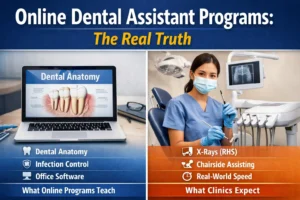
You can complete most of the academic training for dental assisting online, including dental anatomy, infection control, radiology theory, and office procedures.
However, no legitimate path skips hands-on clinical experience entirely. Employers, state dental boards, and certification bodies all expect some level of in-person skill validation.
This is where many students get confused — and where low-quality programs quietly mislead people.
The honest breakdown (what online really means)
| Part of Training | Online Possible? | Reality Check |
|---|---|---|
| Dental anatomy & terminology | ✅ Yes | Fully online, textbook + video based |
| Infection control (OSHA/CDC) | ✅ Yes | Commonly required by employers |
| Dental materials & procedures | ✅ Mostly | Theory online, practice later |
| Radiology (X-ray theory) | ✅ Yes | Hands-on still required |
| Chairside assisting | ❌ No | Must be practiced in a clinic |
| Externship / clinical hours | ❌ No | Required by serious programs |
In practical terms:
Online dental assistant classes work best as a hybrid pathway — learn the theory online, then complete clinical hours through an externship, dental office placement, or employer training.
This is the same model used by well-known providers like Penn Foster, U.S. Career Institute, and MedCerts, all of which explicitly state that hands-on skills must be completed separately.
Are Online Dental Assistant Classes Legit — or a Red Flag?
This is one of the most searched (and misunderstood) questions — and it deserves a clear answer.
When online programs ARE legitimate
Online dental assistant programs are legitimate if they meet three conditions:
- They prepare you for recognized certification
(such as DANB exams like ICE, RHS, or AMP) - They disclose hands-on requirements clearly
(no “100% online clinical training” claims) - They are accredited or recognized by a trusted body
(DEAC, state workforce approval, or employer acceptance)
Programs that meet these standards are widely accepted for entry-level dental assistant roles, especially in states that do not mandate licensure.
When they’re a problem
Be cautious if a program claims:
- “No externship required”
- “Guaranteed job placement”
- “Certified dental assistant in 6 weeks — fully online”
- No mention of state rules or DANB eligibility
These claims do not align with how dental offices actually hire.
In multiple Reddit threads on r/DentalAssistant, working assistants repeatedly warn newcomers that skipping hands-on training makes job placement harder — even if the certificate looks good on paper.
Who Online Dental Assistant Classes Are Best For
Online programs aren’t for everyone — but for the right person, they work extremely well.
Best fit if you are:
- A working adult changing careers
- A parent who needs flexible scheduling
- Someone with access to a local dental office for externship
- Comfortable with self-paced learning
Not ideal if you:
- Want immediate chairside confidence without mentorship
- Live in a state with strict licensing rules and no externship plan
- Learn best only through hands-on instruction
If I were advising a student personally, I’d say this:
Online works best when paired with a real clinic — not as a shortcut.
Why Employers Accept Online Dental Assistant Training
Dental offices care less about where you studied and more about:
- Whether you understand infection control
- Whether you can assist efficiently
- Whether you’re trainable and reliable
Many offices already train assistants on the job, especially for entry-level roles. An online program signals that you:
- Took initiative
- Learned foundational knowledge
- Are prepared for certification exams
That’s why employers routinely hire graduates from online programs when externship or clinic exposure is present.
What Online Dental Assistant Classes Actually Teach (And What They Don’t)
This is where expectations need to be set clearly and honestly.
Online dental assistant classes do teach real, job-relevant knowledge—but they stop short of fully preparing you for chairside work without hands-on exposure.
Think of online training as the academic backbone, not the full body of the job.
Core Subjects Covered in Online Dental Assistant Programs
Most reputable online programs follow a curriculum closely aligned with the industry-standard Modern Dental Assisting textbook (by Bird & Robinson), which is widely used in CODA-accredited in-person programs as well.
Here’s what you actually learn online—and why it matters in a real dental office.
1. Dental Anatomy & Terminology
You’ll study:
- Tooth morphology (incisors, canines, premolars, molars)
- Oral cavity structures (gingiva, alveolar bone, periodontal ligaments)
- Numbering systems (Universal, Palmer, FDI)
Why employers care:
You’re expected to understand instructions instantly—“Prepare for #19 MOD composite” isn’t something you can pause to Google.
2. Chairside Assisting Theory (Without Hands-On Practice)
Online programs teach:
- Four-handed dentistry principles
- Instrument transfer theory
- Procedure sequencing (fillings, crowns, extractions)
You’ll understand what happens during procedures—even if you haven’t physically assisted yet.
This theory-first approach is common. Many dental offices prefer assistants who already understand the why, even if they still need speed and coordination training.
3. Infection Control (OSHA + CDC Standards)
This is one of the strongest parts of online dental assistant education.
Covered topics include:
- OSHA Bloodborne Pathogens Standard
- CDC dental infection-control guidelines
- PPE usage, sterilization, surface disinfection
- Hazard communication (HAZCOM)
Most programs align directly with:
- OSHA.gov infection-control rules
- CDC Oral Health clinical recommendations
Real-world impact:
New hires are often tested on infection control before being allowed chairside.
4. Dental Materials & Instrument Knowledge
You’ll learn:
- Properties of dental materials (composites, amalgams, cements)
- Tray setups (theoretical)
- Instrument identification and purpose
This knowledge helps you anticipate procedures, even if your hands need practice.
5. Office Administration & Dental Software
Many online programs include:
- Dental billing basics
- Insurance terminology
- Appointment scheduling
- Intro to dental software (Dentrix, Eaglesoft concepts)
This makes online-trained assistants especially useful in smaller practices where front-office support matters.
✔ Checklist: Skills You’ll Learn Online
(Ideal as a visual checklist or infographic in the article)
- Dental anatomy & terminology
- Infection control & safety protocols
- Chairside assisting theory
- Dental materials knowledge
- Radiology theory (not exposure)
- Office administration fundamentals
Skills You Cannot Learn Fully Online
This is where honesty builds trust—and where bad programs get exposed.
❌ Taking X-Rays (RHS Certification Skills)
While you can learn radiology theory online, you cannot:
- Position sensors correctly
- Align cones
- Handle patient discomfort
- Meet RHS clinical competency requirements
Hands-on practice is mandatory for the DANB Radiation Health and Safety (RHS) exam and for employer trust.
❌ Chairside Instrument Handling
Watching videos ≠ real chairside readiness.
What can’t be replicated online:
- Instrument transfer speed
- Working without visual cues
- Maintaining asepsis while multitasking
Dental assistants often say this is the hardest part of the job, and it only improves with repetition.
❌ Patient Positioning & Chairside Flow
Real clinics move fast.
You won’t master:
- Chair positioning during procedures
- Adjusting for patient anxiety or movement
- Anticipating dentist preferences
A popular YouTube dental assistant vlogger summed it up well:
“School taught me the steps. The clinic taught me the rhythm.”
❌ Real-World Speed & Confidence
Reddit threads in r/DentalAssistant repeatedly point out:
- Externships matter more than certificates
- Speed comes from doing, not watching
- The first 30–60 days are still a learning curve
Online education shortens that curve—but cannot eliminate it.
The Bottom Line
Online dental assistant classes:
- Teach the knowledge employers expect
- Do not replace hands-on experience
- Work best when paired with externships or in-office training
If a program clearly explains this, it’s usually legitimate.
If it hides it, that’s your red flag.
Accreditation Matters More Than the Course Itself
If there’s one section you shouldn’t skim, this is it.
Most students compare dental assistant programs by price, length, or “100% online” claims. Employers and licensing bodies don’t.
They care about accreditation and exam eligibility—because that’s what signals whether your training meets professional standards.
In short:
A shorter course with the right accreditation beats a longer course with none.
What Accreditation Really Means (DEAC, CODA, State Boards)
Accreditation isn’t just a badge—it’s third-party verification that a program meets defined educational and ethical standards.
But not all accreditation carries the same weight, especially for online dental assistant programs.
DEAC vs CODA: The Difference Most Students Miss
| Factor | DEAC | CODA (ADA) | Non-Accredited |
|---|---|---|---|
| Full name | Distance Education Accrediting Commission | Commission on Dental Accreditation (ADA) | None |
| Primary focus | Online & distance education | In-person dental programs | N/A |
| Common for online programs | ✅ Yes | ❌ Very rare | ⚠️ Often |
| Required for 100% online? | ✅ Yes | ❌ Not designed for it | ❌ |
| Employer perception | Generally accepted | Gold standard | Risky |
| Exam prep alignment | Often DANB-aligned | Fully aligned | Unclear |
Why this matters:
- DEAC accreditation confirms the online delivery meets recognized standards
- CODA accreditation confirms clinical dental training standards
- 100% online programs cannot realistically meet CODA’s clinical requirements
That’s why you’ll almost never see a fully online CODA-accredited dental assistant program—and that’s not a red flag by itself.
Accreditation rules can quietly limit your career options.
Here’s how accreditation impacts real-world eligibility—not just degrees.
How Employers Actually Interpret Accreditation
In real hiring scenarios:
- Dental offices rarely reject DEAC-accredited online certificates
- Employers do reject:
- Unaccredited programs
- Programs that can’t explain clinical training pathways
- Certificates that don’t align with certification exams
Hiring managers often ask:
“Can you take X-rays?”
“Have you done an externship?”
“Are you DANB-eligible?”
Accreditation supports those answers—but hands-on proof seals the deal.
Where to Verify Accreditation (Do This Yourself)
- DEAC official site (.org) – verify the school is listed
- ADA CODA (.org) – confirm clinical accreditation claims
- State dental boards (.gov) – check state-specific requirements
If a program isn’t listed on any of these, that’s your cue to pause.
Will an Online Certificate Let You Sit for the DANB Exam?
Short answer: Sometimes—depending on the exam, the program, and your state.
This question appears constantly in search results because it’s high-stakes. Passing the right exam can directly affect your hiring chances and pay.
DANB Exams Explained
| Exam | What It Covers | Online Prep Possible? |
|---|---|---|
| ICE | Infection control & safety | ✅ Yes |
| RHS | Dental X-ray theory + clinical skills | ⚠️ Theory yes, clinical no |
| AMP | Chairside assisting knowledge | ✅ Mostly |
Many online programs:
- Prepare you academically for ICE and AMP
- Require externships or in-office training for RHS eligibility
If a program claims RHS certification without clinical practice, that’s inaccurate.
State Restrictions You Must Check
- California
Requires state-approved training for X-ray certification
Online theory alone is not sufficient - Texas
Allows entry-level assisting without certification, but RHS requires hands-on validation - Florida
Radiography certification requires board-approved coursework and clinical competencies
These rules change, so always verify with your state dental board (.gov) before enrolling.
Can an online dental assistant certificate qualify you for DANB exams?
Yes—for written exams like ICE and AMP, if the program is properly aligned. For RHS (X-ray certification), hands-on clinical experience is still required, regardless of whether the coursework is online.
The Trust Test: Use This Before Enrolling
Ask any program:
- Which DANB exams does this course prepare me for?
- How do students complete clinical requirements?
- Is the school listed on DEAC or recognized by state boards?
Clear answers = legitimate program
Vague answers = walk away
Best Online Dental Assistant Programs
When you’re searching for “best online dental assistant classes,” you’re standing at a decision point that affects time, money, and your career trajectory.
This section cuts through hype and compares the leading programs based on real-world outcomes, accreditation, clinical requirements, and learner feedback—not marketing slogans.
Quick Comparison Table
Below is a side-by-side comparison of the most reputable online dental assistant programs available in 2025–2026.
You’ll see how they differ in accreditation, duration, cost, clinical/externship support, exam prep, and who each is best for.
| Program | Accreditation | Length | Cost Range* | Externship Support | DANB Prep | Best For |
|---|---|---|---|---|---|---|
| Penn Foster | Regionally recognized | 6–12 months | $$ | Optional/Varies | ICE, AMP | Adults with flexible schedules |
| U.S. Career Institute | DEAC-accredited | ~6–9 months | $$ | Employer/Clinic partnerships | ICE, AMP | Self-paced learners |
| MedCerts | Career-focused accreditation | 4–6 months | $$ | Career services + externships | ICE, AMP | Career changers on deadline |
| Stepful | Emerging online accreditations | 3–6 months | $$ | None | ICE, AMP | Front-office focused learners |
| 90 Day Dental Assistant | Non-accredited | ~3 months | $ | None | Basic theory | Quick intro / entry-level theory |
*Cost ranges are approximate and vary by state, payment plan, and promotions.
If flexibility matters more than speed, some self-paced programs are worth a closer look—especially for working adults or parents.
Program-by-Program Reality Check
Here’s the unvarnished truth about each option — based on Reddit discussions, Trustpilot reviews, student experiences, and official program materials.
We’ll focus on:
- Pros
- Cons
- Who each is actually best for
This isn’t sales copy. It’s practical insight.
Penn Foster – Balanced, Flexible, Widely Recognized
Pros
- Offered under regionally recognized accreditation
- Strong curriculum aligned with formal dental assisting theory
- Prepares for ICE and AMP exams
- Self-paced, largely asynchronous
Cons
- Externship/clinical components not guaranteed — often left to the student
- Longer time commitment than “90-day” programs
- Some students report needing additional hands-on practice after completion
Who it’s best for:
Adult learners who want recognized completion credentials and solid theory without a rigid schedule.
Real learner note:
On Reddit threads like r/DentalAssistant, many graduates say Penn Foster gave them confidence with terminology and protocols — but that their first 30–60 days in a clinic were still a learning curve.
U.S. Career Institute – DEAC-Accredited and Self-Paced
Pros
- DEAC accreditation signals online quality
- Clear curriculum structure with certification prep
- Good pacing for working students
- Employers often accept their graduates
Cons
- Clinical/externship arrangements are typically up to the student
- Some learners report slower response times from support
Who it’s best for:
Students needing accredited online training and a design that fits around work/family life.
According toTrustpilot
Users praise the flexibility and course clarity, noting that the theory portion feels comprehensive.
MedCerts – Career Services + Externship Pathways
Pros
- Focused on job readiness
- Career support, externship assistance more structured
- Shorter overall timeline
Cons
- Accreditation varies by state/program
- Some courses lean more toward theory than deep dental science
Who it’s best for:
Career changers who want structure, support, and a faster path toward placement.
Student feedback:
Several posts on forums highlight positive transitions to entry-level roles, often crediting career services for interview prep and placements.
Stepful – Short, Focused, Front-Office Emphasis
Pros
- Quick completion
- Practical front-office and patient communication focus
- Good starting point if you want to assist administratively first
Cons
- Not a deep clinical theory program
- Limited or no externship support
Who it’s best for:
People targeting administrative dental assistant roles or clinics where clinical duties are secondary.
tip:
Stepful isn’t a full dental clinical pathway — it’s more like a gateway into the field.
90 Day Dental Assistant – Quick Theory Intro
Pros
- Fastest timeline advertised
- Good primer for absolute beginners
- Low cost
Cons
- Non-accredited
- Preparation is basic theory only
- Employers often require additional clinical training
Who it’s best for:
Absolute beginners who want to test interest before committing to a longer program.
Reviews on Reddit and course sites mention it gives “just enough to be comfortable with basics,” but most students still needed another course or in-office training for hire.
How Students Actually Feel (Forums & Ratings)
Here’s a quick snapshot of how real learners describe these programs:
- Penn Foster: “Great theory, but I still needed clinic hours.”
- USCI: “Accredited and reasonable pace.”
- MedCerts: “Helped me get interviews quickly.”
- Stepful: “Good office-focused primer.”
- 90 Day DA: “Fast, but incomplete for real work.”
Trustpilot reference:
Several programs have aggregate ratings between 3.5–4.5 stars, with common praise for flexibility and common criticism for lack of clear hands-on instruction.
Bottom-Line Takeaways Before You Choose
- Accreditation matters more than speed. A fast program is only valuable if employers recognize it.
- Externship/clinical pathways make or break employability. Choose programs that help you connect with real clinics.
- Theory only helps you start the conversation — practice helps you keep the job.
If you want flexible pacing with solid online training and certification prep, programs with DEAC or regional accreditation are worth a look.
How Long Does It Take?
When planning a career shift into dental assisting, timing and budget aren’t “nice to know” — they’re core decision factors. Many online programs advertise “3-month completion,” but the real timeline and financial reality is more nuanced
The Real Timeline: 3 Months vs 12 Months
| Timeline | Typical Path | What’s Included | What’s Not |
|---|---|---|---|
| 3 Months | Fast theory course | Dental terminology + CDC/OSHA infection basics | Clinical skills, externship, RHS certification |
| 6–9 Months | Full online curriculum | Theory + certification prep (ICE/AMP) | Often still needs externship |
| 9–12 Months | Extended path | Theory, exam prep, some externship support | Varies by program & student pace |
Why this matters:
A “3-month dental assistant course” almost always refers to theoretical modules only. If you want to be truly hire-ready — especially for tasks like setting up instruments, chairside pacing, or X-ray competence — you’ll need additional weeks/months of supervised practice in a clinic.
Think of the short programs as academic primers, not complete job training.
How Much Does It Really Cost?
This section gives you data-backed expectations, hidden expenses you must budget for, and common myths (like FAFSA availability) that can throw off planning.
Breakdown: What You’ll Actually Pay (Ranges Based on 2025–2026 Data)
Here’s a realistic cost spectrum for online dental assistant training and related expenses:
| Cost Category | Typical Range | What It Covers |
|---|---|---|
| Online Course Tuition | $800 – $3,000+ | Coursework and online modules |
| Externship/Clinical Fees | $0 – $1,500+ | Clinic supervision, liability insurance |
| DANB Exam Fees | $125 – $495 per exam | ICE, AMP, RHS (RHS often higher) |
| Textbooks & Materials | $50 – $300 | eBooks, workbooks, toolkits |
| Tech/Software Access | $0 – $200 | LMS platforms, practice sims |
| Total Estimated Range | ~$1,000 – $6,000+ | Complete path to job-ready |
Dental assisting isn’t the only fast-track healthcare trade.
Here are other career paths like trading that don’t require a four-year degree.
Example:
If you take a mid-range online program for ~$2,000, then add externship costs around $500, and pay for two DANB exams ($220 + $295), your total is already near $3,015 — and that doesn’t include travel or time off work.
This is backed by official DANB exam fee schedules and common externship charges reported by dental assisting communities (e.g., Reddit, program brochures, and student reports).
Hidden Costs You Shouldn’t Overlook
Many students budget for tuition alone — but there are inevitable add-ons:
🔹 Certification Exam Fees
- ICE: ~ $125
- AMP: ~ $220
- RHS: ~ $295 (often requires documented clinical hours first)
These are official rates from DANB.org and subject to change, but they show how exam costs can stack up quickly.
🔹 Clinical/Externship Fees
Some clinics charge:
- Liability coverage
- Site supervision fees
- Facility costs
These vary widely, but $300–$1,500 is common based on student reports and externship agreements.
🔹 Supplies & Uniforms
Expect to budget for:
- Scrubs
- Student instrument kit
- Protective eyewear
- Hygiene kit
Individual students report $80–$300 depending on quality.
Payment Plans vs FAFSA Myths
Fact:
Most online dental assistant programs are not FAFSA-eligible unless they are part of an accredited college that participates in federal financial aid.
- Programs through community colleges (e.g., BMCC/CUNY) may accept FAFSA.
- Private online programs (e.g., Penn Foster, USCI, MedCerts) usually do not.
Payment plans are common — monthly installments, tuition financing, and employer reimbursement options — but federal aid is rarely an option for standalone online dental assisting certificates.
Practical Cost + Time Roadmap (Visual Concept)
Timeline Bar
Months 0–3     Online theory
Months 3–6     Exam prep + externship setup
Months 6–9     Complete externship + DANB exams
Months 9+      Job search + continuing education
Cost Breakdown Chart
$6,000 |
$5,000 | █████████
$4,000 | ███████
$3,000 | █████
$2,000 | ███
$1,000 | █
$0     |
         Tuition Externship Exams Supplies
What Students Actually Experience (Real-World Voices)
From student forums like Reddit’s r/DentalAssistant and program review sites:
- “I thought I’d be done in three months, but my clinic placement took another six weeks.”
- “Exam fees surprised me — had to retake RHS once.”
- “Externship was free, but I still had to pay for liability coverage.”
These aren’t marketing spears — they’re candid student experiences that help new learners budget realistically.
“How long does dental assistant training take?”
Most reputable online programs take 6–9 months when you include certification prep and clinical exposure. Fast theory courses may say “3 months,” but hands-on skill development and exam readiness usually extend the timeline.
“How much will it cost?”
Total costs typically range from $1,000 to $6,000+, including tuition, exams, externships, and supplies — not just the advertised course fee.
State Licensing Rules Most Students Miss
If you only take one thing from this article, let it be this: state licensing requirements for dental assistants vary drastically, and they are one of the biggest reasons students hit roadblocks after online programs.
Many students enroll in the wrong program for their own state, assuming “online training = national eligibility.” That’s simply not true. State boards decide who can practice, what duties you may perform, and if exams are accepted without local clinical hours.
Below, we explain four states with strict licensing rules and share authoritative links so you can verify the latest requirements directly from official sources.
California — X-Rays & Additional Training Required
California has some of the most rigorous requirements for dental assistants in the nation. Unlike many states that allow entries based solely on coursework, California requires:
- Board-approved courses
- Clinical hours
- Direct supervision for radiography (X-rays)
This means a 100% online program typically will not qualify you for X-ray duties (RHS) unless paired with in-person, supervised training that meets California Board of Dentistry requirements.
Official source: California Dental Board — Licensing Requirements
(Always verify updates on dbc.ca.gov, the official .gov site.)
Why students mess up here:
They complete an online program and assume they’ll be hired immediately with full chairside privileges — only to find that the clinic needs specific state-approved radiography training and documented clinical hours before they can legally use X-ray equipment.
Texas — Certification Helps, But Supervision Rules Apply
Texas is more flexible than California, but still nuanced.
- Certification is not mandatory to assist under general supervision
- Radiography requires specific training and documentation
- Some clinics may prefer or require DANB certifications, even if not state-mandated
Official rules are governed by the Texas State Board of Dental Examiners.
Exact language and updates should always be verified at tsbde.texas.gov.
Common trap:
Many students think completing an online RHS prep means they can start taking X-rays first day on the job. In Texas, supervised clinical experience is still expected before X-ray duties are assigned.
Florida — Rigid Radiography & Skill Validation
Florida requires:
- Specific radiography coursework approved by the Board
- Clinical demonstration of competency before radiography duties are permitted
Online programs may cover the theory, but unless the curriculum is approved in Florida or paired with hands-on validation, you may not be eligible to perform X-ray duties.
Official source: Florida Board of Dentistry Regulatory Information
Confirm current standards at floridasdentistry.gov.
Why this matters:
Even if an online dental assistant certificate covers RHS prep terminology, Florida’s board may require separate approved training or documented clinical experience.
New York — Mix of Certification + Supervised Experience
New York doesn’t license dental assistants the same way it licenses dentists or hygienists, but it does enforce:
- Demonstrated competence in certain procedures
- Documented clinical exposure
- Employer-specific requirements
The New York State Education Department Office of the Professions provides the official framework — always verify at op.nysed.gov.
Many New York clinics personally require DANB certifications or demonstrable clinical experience before assigning duties such as radiography or complex chairside support.
Why State Rules Matter More Than Program Marketing
Programs often advertise:
- “Prepare for national exams”
- “Learn at your own pace”
- “100% online”
None of these guarantees you can practice full duties in every state.
Licensing and practice rules are set by state dental boards (.gov) — not by the program.
That’s why your first step after choosing a program should be:
Verify requirements with your state’s official dental board
- Look for official scope of practice documents
- Check requirements for RHS/radiography
- Confirm required clinical hours or approved training
This protects you from investing time and money into a program that won’t qualify you for the duties you want to perform.
Takeaways
Do state licensing rules affect online dental assistant training?
Yes. States like California, Texas, Florida, and New York have specific requirements for radiography, clinical hours, and supervised duties that online coursework alone does not satisfy. Always verify eligibility with your state dental board (.gov) before enrolling.
Quick Links for State Boards (Verify Before You Enroll)
- California Dental Board —dbc.ca.gov
- Texas State Board of Dental Examiners — tsbde.texas.gov
- Florida Board of Dentistry — floridasdentistry.gov
- New York State Education Department — nysed.gov
Job Outlook, Salary & the Real Hiring Reality for Dental Assistants
Dental assisting is still in demand, but online certificates alone don’t guarantee strong pay or fast hiring. According to the U.S. Bureau of Labor Statistics (.gov), employment for dental assistants is growing faster than average due to increased patient volume and preventive care needs.
Salary Reality (2025-26 ranges)
- Entry-level (no certification): ~$32,000–$38,000/year
- Certified or RHS-eligible: ~$40,000–$48,000/year
- Experienced / expanded duties: $50,000+
Employers consistently pay more for assistants who can legally take X-rays and assist chairside with minimal supervision.
What Employers Actually Look For
Based on job listings from Indeed and Glassdoor and clinic hiring trends:
- State-approved radiography eligibility
- Hands-on experience (externship or clinic exposure)
- Chairside efficiency, not just theory
- DANB exam readiness (RHS, ICE, AMP)
Many private clinics accept online training only if it’s paired with externships or certification prep. Corporate dental chains are more open to online graduates, while specialty clinics usually require in-person experience.
Bottom Line
Online dental assistant programs can lead to jobs, but higher pay and faster hiring depend on state eligibility, X-ray certification, and real clinical exposure—not the certificate itself.
FAQs On
Are online dental assistant programs respected?
Yes—but only when paired with state eligibility, externships, or DANB exam prep. Employers respect online programs that follow OSHA/CDC standards and prepare students for real chairside work. A certificate alone matters less than whether you can legally take X-rays and assist efficiently.
Can I work as a dental assistant without certification?
In some states, yes. Many clinics hire entry-level assistants without certification, but your duties and pay are limited. Without RHS or DANB exams, you usually can’t take X-rays, which restricts job options and long-term growth.
What’s the fastest path to becoming a dental assistant?
The fastest route is a self-paced online program (3–6 months) combined with externship placement or DANB RHS exam prep. This approach gets you hired quicker than classroom programs—if your state allows online-trained assistants.
Can parents or full-time workers manage online dental assistant classes?
Yes. Most online programs are asynchronous, allowing study at night or weekends. Parents and full-time workers succeed when programs offer flexible pacing, mobile-friendly lessons, and optional externships scheduled locally instead of fixed class hours.
Final Verdict: Are Online Dental Assistant Classes Worth It?
Online dental assistant classes can absolutely work, but only for the right student in the right state. They’re best for learners who need flexible schedules and are willing to pair online theory with externships, certification prep, or state-approved pathways.
What matters most isn’t the certificate—it’s whether the program:
- Aligns with your state’s dental board rules
- Prepares you for DANB exams (especially RHS)
- Gives you real clinical exposure, not just videos
If you skip those checks, people end up with a certificate they can’t legally use. That’s where most students get stuck.
Decision Checklist: Is an Online Program Right for You?
✅ Online dental assistant programs make sense if:
- Your state allows on-the-job or entry-level dental assistants
- The program prepares you for RHS, ICE, or AMP exams
- You can secure an externship or hands-on clinic experience
- You need self-paced or evening study (parents, full-time workers)
- You understand this is a career entry point, not instant licensing
Think twice if:
- Your state requires CODA-accredited education
- You expect X-ray certification without clinical training
- The program offers no externship, no exam prep, no state guidance
- You’re being promised “job guaranteed” or “licensed in all states”
One-Sentence Takeaway
Online dental assistant classes are legitimate when combined with state eligibility, certification prep, and real clinical experience—but risky if taken in isolation.

Nawab, an educator teaching K-12 and College since 2010, holds an English honors degree and a teacher’s training course. He has also been blogging for five years, sharing insights for educators and parents.