
If you’re a student or parent trying to make sense of report cards and college prep, you’ve probably come across terms like weighted GPA and unweighted GPA.
To convert use our tool Weighted vs. Unweighted GPA Converter.
Many of the Best U.S. High Schools use a weighted GPA system to evaluate student performance. At first glance, they might seem like small details, but understanding how these grading systems work can make a big difference—especially when it comes to standing out in college admissions.
Ready to dive in? Let’s get started!
Weighted vs Unweighted GPA: What’s the Difference?
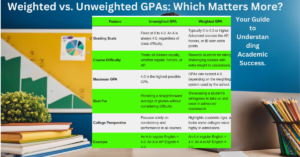
A weighted GPA gives extra points for harder classes like AP or Honors, often allowing GPAs above 4.0. An unweighted GPA uses a standard 4.0 scale and treats all classes equally. Schools use both to evaluate academic performance and course rigor..
Here’s a detailed comparison chart for weighted vs. unweighted GPAs:
| Feature | Unweighted GPA | Weighted GPA |
|---|---|---|
| Grading Scale | Fixed at 0 to 4.0. An A is always 4.0, regardless of class difficulty. | Typically 0 to 5.0 or higher. Advanced courses like AP, honors, or IB earn extra points. |
| Course Difficulty | Treats all classes equally, whether regular, honors, or AP. | Rewards students for taking challenging classes with extra weight in calculations. |
| Maximum GPA | 4.0 is the highest possible GPA. | GPAs can exceed 4.0, depending on the weighting system used by the school. |
| Best For | Providing a straightforward average of grades without considering difficulty. | Showcasing a student’s willingness to take on and excel in advanced coursework. |
| College Perspective | Focuses solely on consistency and performance in all courses. | Highlights academic rigor, a factor some colleges value highly in admissions. |
| Example | An A in regular English = 4.0. An A in AP English = 4.0. | An A in regular English = 4.0. An A in AP English = 5.0. |
Understanding GPA is essential for academic and career success. For a complete overview, explore our Understanding GPA: A Comprehensive Guide.
You can use this letter-to-GPA calculator to get an accurate starting point before weighting adjustments.
What Is a Weighted GPA?
A weighted GPA is a grade point average that gives extra points for harder classes like AP, Honors, or IB courses. Unlike a standard GPA, it can go above 4.0, which helps schools reflect course difficulty, not just grades. This is why students in advanced classes often have higher weighted GPAs.
Weighted GPA Scale (Example)
| Grade | Regular Class | Honors / AP Class |
|---|---|---|
| A | 4.0 | 5.0 |
| B | 3.0 | 4.0 |
| C | 2.0 | 3.0 |
Real Example
If a student earns an A in AP Biology, it may count as 5.0 instead of 4.0, boosting their weighted GPA compared to a student taking only regular classes.
What Is an Unweighted GPA?
An unweighted GPA is a grade point average calculated on a standard 4.0 scale, where all classes are treated the same. It does not consider course difficulty, making it easier to compare students across different schools. Most colleges use unweighted GPA as a baseline for academic consistency.
Unweighted GPA Scale (Standard)
| Grade | GPA Value |
|---|---|
| A | 4.0 |
| B | 3.0 |
| C | 2.0 |
| D | 1.0 |
| F | 0.0 |
Real Example
A student who earns an A in AP Math and an A in a regular Math class receives 4.0 for both in an unweighted GPA, even though the courses differ in difficulty.
Now, let’s see GPA comparisons for Emma and Alex, illustrating how their grades differ under both systems.
| Student | Course Type | Grade | Unweighted GPA | Weighted GPA |
|---|---|---|---|---|
| Emma | AP Physics | A | 4.0 | 5.0 |
| Alex | Regular Physics | A | 4.0 | 4.0 |
Which GPA Matters More: Weighted or Unweighted?
Colleges consider both weighted and unweighted GPA, but they look at each for different reasons. Unweighted GPA helps admissions officers compare students fairly across schools, while weighted GPA shows how challenging your course load was. Many colleges recalculate GPA using their own formula during admissions review.
How Colleges Actually Use Each GPA
- Highly selective colleges look at both GPAs, but place extra emphasis on course rigor alongside grades.
- State and public universities often rely more on unweighted GPA for baseline eligibility and comparisons.
- Scholarships and honors programs may use weighted GPA to reward students who took harder classes.
If your weighted GPA looks lower because your school doesn’t offer many advanced classes, colleges evaluate your GPA in the context of what your school provides—not against schools with different systems.
How Advanced Courses Boost Weighted GPAs
Taking advanced courses like Honors, AP, or IB programs can significantly impact your GPA, especially when schools use a weighted system.
These courses not only challenge students academically but also reward them with higher GPA points, making them a critical part of standing out in college applications. Let’s explore how these courses contribute to boosting your weighted GPA.
Understand the common challenges that can affect your GPA and learn strategies for overcoming them effectively.
Why Honors, AP, and IB Courses Matter
Advanced courses are designed to push students beyond the standard curriculum, encouraging critical thinking, problem-solving, and mastery of complex subjects. But their benefits don’t stop at learning—they also come with a GPA boost:
- Honors Courses: Typically add 0.5 points to your GPA. For example, an A in an honors class might be worth 4.5 instead of 4.0.
- AP and IB Courses: Offer even more weight, often adding 1.0 point. Scoring an A in an AP Biology class could translate to a 5.0 GPA.
For AP English exams, writing in active voice can help essays earn higher scores.
Even simple factors like clear grammar can influence how teachers assess essays in honors or AP classes
Variations in Weighted GPA Policies Across Schools
Not all schools use the same weighting system. While one school might add a full point for AP courses, another might only add 0.7. Here’s how different policies can impact GPA calculations:
- Standard Weights: Some schools follow a consistent scale (e.g., +0.5 for honors, +1.0 for AP/IB).
- Customized Weights: Others vary the weights based on subject difficulty or school-specific guidelines.
- Cap on Weighted GPAs: Certain schools may limit the maximum GPA, such as capping it at 5.0 or requiring a minimum grade to qualify for the boost.
To see how grading systems differ and adapt to these variations, visit Grade Calculator Guide.
How Advanced Courses Boost Weighted GPAs
Taking advanced courses like Honors, AP, or IB programs can significantly impact your GPA, especially when schools use a weighted system.
These courses not only challenge students academically but also reward them with higher GPA points, making them a critical part of standing out in college applications. Let’s explore how these courses contribute to boosting your weighted GPA.
Why Honors, AP, and IB Courses Matter

Advanced courses are designed to push students beyond the standard curriculum, encouraging critical thinking, problem-solving, and mastery of complex subjects. But their benefits don’t stop at learning—they also come with a GPA boost:
- Honors Courses: Typically add 0.5 points to your GPA. For example, an A in an honors class might be worth 4.5 instead of 4.0.
- AP and IB Courses: Offer even more weight, often adding 1.0 point. Scoring an A in an AP Biology class could translate to a 5.0 GPA.
Related Post: What is Cumulative GPA and How to Calculate It.
Variations in Weighted GPA Policies Across Schools
Not all schools use the same weighting system. While one school might add a full point for AP courses, another might only add 0.7. Here’s how different policies can impact GPA calculations:
- Standard Weights: Some schools follow a consistent scale (e.g., +0.5 for honors, +1.0 for AP/IB).
- Customized Weights: Others vary the weights based on subject difficulty or school-specific guidelines.
- Cap on Weighted GPAs: Certain schools may limit the maximum GPA, such as capping it at 5.0 or requiring a minimum grade to qualify for the boost.
If you’re new to how GPAs work, you might also want to explore U.S. Public School Grading Scales for more background on how grades translate to GPAs. And if you’re curious about tools to simplify calculations, check out our guide to the Top Free Grade Calculator Tools to stay on track.
Weighted vs. Unweighted GPA: Step-by-Step Calculations
Understanding the difference between weighted and unweighted GPAs becomes easier with real-life examples. Let’s break it down step by step for two students: one taking regular classes and another enrolled in advanced courses.
To convert use our tool Weighted vs. Unweighted GPA Converter.
Example of an Unweighted GPA Calculation
Unweighted GPAs use a standard scale where grades are valued the same, regardless of course difficulty. Here’s how it works:
Scenario: Student A with Regular Classes
- Courses and Grades:
- English: A (4.0)
- Math: B (3.0)
- Science: A (4.0)
- History: B (3.0)
- PE: A (4.0)
Step-by-Step Calculation:
- Add up all grade points:
4.0+3.0+4.0+3.0+4.0=18.0 - Divide by the total number of classes:
18.0÷5=3.6
Unweighted GPA: 3.6
For realistic methods to raise your GPA fast, check out this post.
Example of a Weighted GPA Calculation
Weighted GPAs give extra points for honors, AP, or IB courses to reward academic rigor.
Scenario: Student B with Advanced Classes
- Courses and Grades:
- Honors English: A (5.0)
- AP Math: B (4.0)
- Regular Science: A (4.0)
- AP History: A (5.0)
- PE: A (4.0)
Step-by-Step Calculation:
- Assign grade points based on course type:
- Honors English: A → 5.0
- AP Math: B → 4.0
- Regular Science: A → 4.0
- AP History: A → 5.0
- PE: A → 4.0
- Add up all grade points:
5.0+4.0+4.0+5.0+4.0=22.0 - Divide by the total number of classes:
22.0÷5=4.4
weighted GPA: 4.4
Manually calculating your GPA can be tricky, especially with weighted and unweighted systems. Why not let a tool do the work for you? Check out the best free grade calculators to get accurate results instantly!
Weighted vs. Unweighted GPA: How They’re Calculated
The table below breaks down the step-by-step GPA calculations for both weighted and unweighted systems, helping you see the clear differences and advantages of advanced courses.
Whether you’re planning your high school curriculum or evaluating your grades, this guide offers a practical comparison to simplify GPA tracking and boost your academic strategy.”
Unweighted GPA Calculation: Standard Course Load
| Course | Grade | Type | Grade Points (Unweighted) | Grade Points (Weighted) |
|---|---|---|---|---|
| English | A | Regular | 4.0 | 4.0 |
| Math | B | Regular | 3.0 | 3.0 |
| Science | A | Regular | 4.0 | 4.0 |
| History | B | Regular | 3.0 | 3.0 |
| PE | A | Regular | 4.0 | 4.0 |
| Total Points | 18.0 | 18.0 | ||
| GPA (Unweighted) | 3.6 |
Weighted GPA Calculation: Advanced Courses Boost
| Course | Grade | Type | Grade Points (Unweighted) | Grade Points (Weighted) |
|---|---|---|---|---|
| Honors English | A | Honors | 4.0 | 5.0 |
| AP Math | B | AP | 3.0 | 4.0 |
| Science | A | Regular | 4.0 | 4.0 |
| AP History | A | AP | 4.0 | 5.0 |
| PE | A | Regular | 4.0 | 4.0 |
| Total Points | 19.0 | 22.0 | ||
| GPA (Weighted) | 4.4 |
Key Insights from the Table
- Regular classes don’t impact GPA differently in weighted systems, as they remain on the 4.0 scale.
- Advanced courses (AP or honors) provide an opportunity to boost weighted GPA, rewarding academic rigor.
Want to learn more? Explore our guide on Top Free Grade Calculator Tools to track your GPA!
How Colleges View Weighted and Unweighted GPAs
“Admissions committees don’t just look at your GPA—they consider the rigor of your coursework. A 3.8 with AP classes may be stronger than a 4.0 in easy courses.“ — Jane Doe, College Admissions Consultant
When it comes to college admissions, your GPA isn’t just a number—it’s a reflection of your academic effort, consistency, and course choices.
Admissions officers evaluate GPAs in the context of your school’s grading system and the rigor of your coursework.
Whether your GPA is weighted or unweighted, colleges look beyond the surface to understand your academic journey. What Do Colleges Say? Official GPA Guidelines & Sources.
Is weighted GPA better than unweighted?
In many cases, weighted GPAs can have an edge because they showcase the difficulty of your classes. A 4.5 weighted GPA might tell colleges you challenged yourself with honors, AP, or IB courses—showing you’re ready for the demands of higher education.
For instance, competitive schools like Harvard and Stanford often emphasize the importance of a rigorous curriculum over a perfect 4.0 unweighted GPA.
That said, some schools, particularly state universities, may focus more on your unweighted GPA to maintain fairness across different high school grading systems.
For example, the University of California system recalculates GPAs to ensure equal consideration for all applicants.
How GPA Affects College Admissions
Admissions officers value rigor because it demonstrates a student’s ability to take on challenges. A transcript filled with advanced courses like AP Calculus or IB Biology signals a strong work ethic and academic dedication. Even if your weighted GPA is slightly lower, showing you’ve pushed yourself can leave a positive impression.
Your GPA isn’t just a number—it plays a huge role in college applications. But how do grading scales impact your overall performance? Learn how U.S. public school grading scales work and how they influence your academic profile.
Factors Colleges Consider in Admissions

Keep in mind that GPAs are just one piece of the puzzle. Colleges also consider essays, extracurricular activities, and test scores when making admissions decisions. Understanding how letter grades translate into GPAs can provide more clarity about your academic standing. For a deeper dive, explore what letter grades mean in U.S. schools to see how they factor into overall evaluations.
Debunking Myths About GPAs
When it comes to GPAs, there’s no shortage of misconceptions that can lead to unnecessary stress or confusion. Let’s set the record straight by addressing some of the most common myths about weighted and unweighted GPAs. Debunk misconceptions with data from NACAC.
Myth 1: Weighted GPAs Always Matter More
It’s easy to think that a higher weighted GPA will automatically make you stand out to colleges. While a weighted GPA does reflect the rigor of your coursework, colleges look at more than just numbers.
Admissions officers often evaluate your unweighted GPA to get a clearer picture of your grades, alongside your course load, extracurriculars, essays, and recommendations.
Truth: A high weighted GPA is impressive, but it won’t guarantee college acceptance. A well-rounded application matters just as much.
Myth 2: All Schools Calculate GPAs the Same Way
Many students assume that GPAs are standardized across schools, but that’s far from true. Grading scales, weighting policies, and GPA thresholds vary widely.
For example, some schools use a 4.0 scale, while others might use a 5.0 or even 6.0 scale for weighted GPAs.
This inconsistency means that comparing GPAs directly between schools can be tricky.
Truth: Your GPA’s meaning depends on your school’s specific grading and weighting policies, which is why context matters in admissions decisions.
Looking for tools to help improve your study habits? Check out our list of Free Study Tools for Students: Websites & Resources to enhance your learning experience.
FAQs On Weighted vs Unweighted GPAs
Q1: What Is the Weighted GPA Scale?
The weighted GPA scale usually ranges from 0 to 5.0, though some schools use 4.5 or 6.0 scales. Extra points are added for advanced courses like AP, Honors, or IB, allowing GPAs to exceed 4.0. Each school sets its own weighting rules.
Q2: What’s a Good Unweighted GPA?
A good unweighted GPA is typically 3.0 or higher on a 4.0 scale. Competitive colleges often see 3.5+ as strong, while top-tier schools usually admit students closer to 3.8–4.0. Context matters, including course difficulty and school standards..
Q3: What does a weighted GPA tell colleges?
A weighted GPA signals to colleges that you’ve challenged yourself by taking rigorous courses, such as honors, AP, or IB classes. It highlights not only your academic performance but also your willingness to push yourself academically. Admissions officers often view a strong weighted GPA as an indicator of preparation for college-level work.
Q4: How is an unweighted GPA calculated?
An unweighted GPA is calculated by averaging the grades you’ve earned in all your courses on a standard 4.0 scale. For example:
An “A” is 4.0,
A “B” is 3.0,
A “C” is 2.0, and so on.
To see step-by-step calculations, refer to the Examples of GPA Calculations section for detailed scenarios.
Q5: Are weighted GPAs a good idea?
Weighted GPAs have both advantages and disadvantages.
Pros:
Reward students for taking more challenging courses.
Encourage academic growth and rigor.
Cons:
Can vary greatly between schools, making them harder to compare.
May cause stress for students aiming to maximize their weighted GPA.
Overall, weighted GPAs are beneficial when they’re used to reflect academic effort and success in advanced coursework accurately.
Q6: Does a weighted or unweighted GPA affect a college application?
Both weighted and unweighted GPAs are important in college admissions. Many colleges recalculate GPAs to a standardized scale to fairly compare applicants. Admissions officers also consider the context of your high school, the courses offered, and your academic rigor. Ultimately, your GPA—weighted or unweighted—is just one part of a holistic review process.
Is Cumulative GPA Weighted or Unweighted?
It depends on your school. Many schools report both cumulative weighted and unweighted GPAs on transcripts.
Which Classes Are Unweighted in High School?
Unweighted classes are typically standard or regular-level courses that do not receive extra GPA points. These often include core subjects taught at the regular level, electives, and non-honors classes. Advanced courses may count as unweighted at some schools depending on policy.
Whether your GPA is weighted or unweighted, you can still improve it before the semester ends. Find out the best ways to raise your GPA quickly!
🔹 The Best Way to Check Your GPA Regularly
Looking for more tools to simplify your academic planning? Explore our GPA Calculator guide to take the guesswork out of GPA calculations and track your progress with ease.
If your GPA qualifies for merit aid, you’ll find more options in our list of scholarships for high school seniors.

Nawab, an educator teaching K-12 and College since 2010, holds an English honors degree and a teacher’s training course. He has also been blogging for five years, sharing insights for educators and parents.