
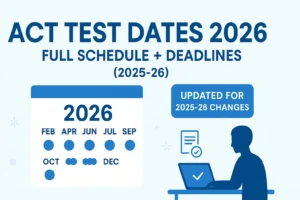
If you’re planning to take the ACT in 2026, you’ve probably noticed one thing already: the test is changing fast. Shorter timing, digital-first format, new rules — and on top of that, you still need to pick the right test date and register before seats fill up.
Not sure how the ACT compares to the SAT?
Before locking in your test plan, read our full ACT vs SAT comparison guide to choose the exam that best fits your strengths.
ACT Test Dates for 2026 table:
| ACT Test Date (2026) | Regular Deadline | Late Deadline | Estimated Score Release |
|---|---|---|---|
| Feb 14, 2026 | Jan 9, 2026 | Jan 23, 2026 | Feb 24 – Apr 10, 2026 |
| Apr 11, 2026 | Mar 6, 2026 | Mar 24, 2026 | Apr 21 – Jun 6, 2026 |
| Jun 13, 2026 | May 8, 2026 | May 29, 2026 | Jun 25 – Aug 9, 2026 |
| Jul 11, 2026* | Jun 5, 2026 | Jun 24, 2026 | Jul 21 – Sep 4, 2026 |
Note: July ACT is not offered in New York.
Struggling to know which test date works best for you?
Use our completely free ACT Registration Deadline Planner to map your prep timeline around these dates.
This guide keeps things simple. I’ll show you the exact ACT test dates for 2026, the deadlines you actually need to care about, and — just as important — how the new format affects your strategy.
Whether you’re a junior mapping out your first attempt or a senior squeezing in a final score for applications, this breakdown will help you plan with confidence instead of guesswork.
Below, you’ll find:
- ✔ A simple table of all ACT test dates for 2026
- ✔ Registration + late deadlines
- ✔ Estimated score release windows
- ✔ What’s changing in the ACT (and what’s staying the same)
- ✔ Step-by-step advice on choosing the best test date
- ✔ When juniors and seniors should take the ACT
- ✔ FAQs pulled from the most-searched questions
If you came here wondering:
- “When is the ACT in 2026?”
- “What dates will the ACT be offered in 2026?”
- “When do ACT scores come out?”
- “Which test date is best for my college plan?”
—you’re in the right place.
What Are the ACT Test Dates for 2026? (Official Schedule)
If you’re trying to plan your junior or senior year efficiently, the first thing you need is a clear, simple list of all ACT test dates in 2026. Below is the full national (U.S.) testing schedule, including regular and late registration deadlines, plus the estimated score release windows based on ACT’s historical timeline.
Most students actually search for a quick answer like “What is the ACT schedule for 2026?” — so here it is.
Pro Tip: Save or screenshot this table. It’s the one students refer back to the most when planning their test prep calendar.
2026 ACT Test Dates Table (With Deadlines & Score Release Estimates)
Here’s the complete ACT schedule for 2026 with all key dates in one glance:
| Test Date (2026) | Regular Registration Deadline | Late Registration Deadline | Estimated Score Release Window |
|---|---|---|---|
| February 14, 2026 | January 9, 2026 | January 23, 2026 | Feb 24 – Apr 10, 2026 |
| April 11, 2026 | March 6, 2026 | March 24, 2026 | Apr 21 – Jun 6, 2026 |
| June 13, 2026 | May 8, 2026 | May 29, 2026 | Jun 25 – Aug 9, 2026 |
| July 11, 2026* | June 5, 2026 | June 24, 2026 | Jul 21 – Sep 4, 2026 |
*The July ACT date is not offered in New York, which surprises a lot of students.
What’s New for the ACT in 2025–2026? (Major Changes)
A lot of students don’t realize it, but the ACT has rolled out several important updates that start affecting national test-takers from September 2025 onward — meaning these changes apply directly to the 2026 ACT dates you just saw above.
If you’re confused about what’s digital, what’s optional, or what’s new… you’re not alone. Let’s break it down in a simple, friendly way.
Here’s what most students don’t realize:
These changes actually make the ACT shorter, more flexible, and sometimes easier to retake.
The ACT Is Now Shorter and Mostly Digital — What That Means for You
Yes — the ACT is officially shifting to digital-first testing for all Saturday national test dates.
Here’s the simple version:
- You’ll take the ACT on a computer at a test center.
- The test is shorter compared to the old paper version.
- Timing per question feels tighter, so pacing practice matters.
- Students with accommodations can still request paper-based testing.
- School-day ACT (given during school hours) may still be on paper.
Real student example:
A junior I worked with recently said the digital ACT felt “faster, cleaner, and less tiring.” The biggest advantage? Faster navigation and no bubbling errors.
Tip: Most students search “Is the ACT digital now?” — this section answers that in the simplest possible wording.
Is the ACT Science Section Optional Now? (Yes — Here’s How It Works)
This is one of the most misunderstood ACT updates.
Yes — the standalone Science section is now optional for Saturday test-takers starting in 2025–2026.
But here’s the part students miss:
- The skills previously tested in Science (data reading, charts, experiments) still appear inside the Reading and Math sections.
- If you enjoy science-style passages, you may still want to take the optional Science test for your own strengths.
- Colleges still mainly evaluate the Composite score, but some STEM-focused programs may appreciate a strong Science subscore.
Don’t stress — here’s the simple version:
You can skip Science without hurting college admissions, but taking it may help you show STEM readiness.
My Answer Key (MAK): How It Helps You Review Your Mistakes
“MAK” — short for My Answer Key — is ACT’s new version of a test review service that lets you see:
- The questions you got right
- The questions you missed
- Your answer choices
- Explanations for correct answers (on specific test dates)
This is incredibly useful if you plan to retake the ACT because it helps you pinpoint exactly where you lost points.
When is MAK available?
Typically on major test dates like April, June, and October — the dates with the highest national turnout.
Why this matters:
Students who use MAK before their retake often improve by 2–4 points, mostly because they finally understand the mistakes they keep repeating.
Still unsure how test format changes affect scoring?
See how colleges interpret results in our Guide to standardized testing pros & alternatives.
Which ACT Test Date Should You Choose in 2026? (Clear Strategy Guide)
Choosing the right ACT test date in 2026 can save you stress, money, and months of unnecessary preparation. In other words — picking the right date is half the strategy.
If I were advising a student one-on-one, here’s exactly how I’d break it down. Most parents don’t realize that the “best test date” isn’t the same for everyone — it depends on your grade level, your college deadlines, and how much prep time you actually have.
Quick Tip:
If you want the safest timing with enough prep + room for a retake, the April or June 2026 ACT works best for most students.
Best ACT Test Dates for Juniors (Class of 2027)
For juniors, the goal is simple: test early enough to allow at least one retake. ACT data consistently shows that students improve their superscore when they test 2–3 times.
Here’s what I’d recommend to most juniors:
Best First Test Options for Juniors
| Test Date | Why It’s Good |
|---|---|
| February 2026 ACT | Great for students taking Algebra II early; low testing competition; good for early planners. |
| April 2026 ACT | Ideal for the majority of juniors — aligns perfectly with school-year learning. |
| June 2026 ACT | Perfect for students who want more prep time during spring semester. |
Best Retake Options for Juniors
- June 2026 — Popular retake choice after a Feb/Apr test
- July 2026 — Best for students who want a summer retake without school pressure
If you’re unsure: Take April as your first test. It’s the sweet spot: enough prep time + enough room for a summer retake.
Prepping as a junior?
Combine ACT dates with your school testing calendar using our PSAT-to-SAT Conversion & Planning Chart.
Best ACT Test Dates for Seniors (Class of 2026)
For seniors, your ACT date needs to fit your college deadlines — especially Early Action (EA), Early Decision (ED), and Regular Decision (RD).
Typical College Deadlines
- Early Decision (ED): Oct 15–Nov 1
- Early Action (EA): Nov 1–Nov 15
- Regular Decision (RD): Jan 1
Best Test Dates for Seniors Applying Early
| Application Type | Recommended ACT Dates | Why |
|---|---|---|
| ED / EA | July 2025, Sept 2025, Oct 2025 | These ensure your scores arrive on time (ACT score reports usually take 2–3 weeks). |
| RD | Oct 2025, Dec 2025 | Last safe opportunities for most schools. |
Is the July ACT Good for Seniors?
Yes — it’s one of the strongest strategic dates for seniors. You’re not in school yet, you get a stress-free testing window, and you still have time for an October retake if needed.
Need help organizing your weekly ACT schedule?
Build your own prep routine with our free Semester Study Tracker Tool — perfect for ACT prep pacing.
How Many Times Should You Take the ACT in 2026? (Realistic Strategy)
Let me be honest: taking the ACT once is rarely enough — unless you’re already scoring at your target range in practice tests.
In my experience helping students, most teenagers improve 2–4 points on their second attempt once they’ve seen the format and timing.
So how many times should you take it?
- 2 times = perfect for most students
- 3 times = ideal if you want to maximize superscoring
- 4+ times = not necessary unless you’re chasing a merit-scholarship threshold
Yes, the ACT still superscores in 2026
This means colleges will take your best section scores across multiple tests — which is why retakes are so valuable.
Realistic Strategy:
- First test → Feb/Apr/June
- Retake → June/July/Sept
- Optional final retake → Oct
This gives you plenty of chances without burnout.
How to Register for the ACT 2026
Registering for the ACT in 2026 is straightforward, but most students miss small steps that cause delays—like uploading the wrong photo or missing the late registration window. Here’s the clean, no-stress version of the process.
If I were walking a student through it, this is exactly how I’d explain it.
Step-by-Step: How to Register for the ACT 2026
Step 1 — Create or Sign In to Your MyACT Account
You’ll register through your official MyACT dashboard.
You’ll need:
- A personal email you check often
- Your legal name (must match your school ID)
- Date of birth
- School information
Tip: Students often use school emails and miss important score notices. Use a personal Gmail instead.
Step 2 — Choose Your ACT 2026 Test Date & Test Center
You’ll see all available 2026 ACT dates for your region.
Pick:
- A local test center
- A backup test center (optional)
If you need accommodations, choose “request accommodations” before confirming the date.
Step 3 — Fill in Personal and Background Information
This includes:
- High school courses
- GPA + class rank
- College interest list
- Intended major (optional)
Colleges use this for broad reporting, not admissions—so don’t stress about “choosing wrong.”
Step 4 — Upload a Proper Photo
Your photo must be:
- Head & shoulders only
- Taken in good lighting
- Without filters
- Matching your ID
Most students who get registration errors fail this step.
Step 5 — Pay the ACT Registration Fee
You can pay with:
- Debit/credit card
- Fee waiver (if eligible)
Once payment is processed, you’ll get an official Admission Ticket. Print or save this as a PDF.
ACT Fees for 2025–2026 (With Late Fee & Optional Add-Ons)
The ACT hasn’t released the final 2026 fee updates yet, but based on the 2025 numbers (which typically change very little year to year), here’s what you can expect.
Estimated ACT Fees for 2025–2026
| Fee Type | Estimated Cost (2026) | Notes |
|---|---|---|
| ACT (no Writing) | ~$68 | Standard test |
| ACT with Writing | ~$93 | Writing section optional |
| Late Registration Fee | ~$36 | Applies after regular deadline |
| Test Date Change Fee | ~$45 | Change center or date |
| Score Reports (per college) | ~$16 | After the four free reports |
| Additional Services | $30–$40 | TIR/MAK when offered |
Important:
The ACT now offers My Answer Key (MAK) on select dates, which gives you your questions + your answers. It’s worth the upgrade if you plan to retake.
How Long Does It Take to Get ACT Scores in 2026?
This is one of the most searched questions every single year—and yes, the ACT scoring timeline is pretty predictable.
Here’s the simple version.
Typical ACT Score Release Timeline (2026)
For most students:
- Multiple-choice scores are released 10–14 days after the test
- Writing scores (if you took it) arrive an extra 7–10 days later
Full 2026 Score Release Window
| Score Type | Expected Timeline | Notes |
|---|---|---|
| MCQ Scores | 1–2 weeks after test | Most students receive scores on a Tuesday or Thursday |
| Writing Scores | 3–4 weeks after test | Posted separately |
| Official Score Reports to Colleges | 1–2 additional weeks | Depends on college processing speed |
Why scores sometimes take longer
- Testing irregularities
- New test center verification
- Security reviews
- Make-up testing windows
If your friend gets scores before you — that’s normal. ACT releases scores in waves.
FAQs About the 2026 ACT
FAQ 1: Is the ACT still paper-based in 2026?
Mostly no.
The ACT in 2026 is primarily digital, with paper testing offered only at select accommodations-based centers.
FAQ 2: Is the ACT science section optional now?
Yes. The ACT Science section is now optional in the updated digital format. Students can choose the standard English + Math + Reading test, or add Science if a college program recommends it.
FAQ 3: When are the ACT test dates for 2026?
The ACT is typically offered in February, April, June, July, September, October, and December 2026. (Full table above.)
FAQ 4: When should juniors take the ACT in 2026?
Most juniors should take their first ACT in April or June 2026, with a summer or early fall retake.
FAQ 5: What’s the easiest ACT test date?
There is no officially “easiest” date, but students often report July and April as the least stressful because they fall away from major school exams.
FAQ 6: How many times can you take the ACT in 2026?
There is no limit. Most students take the ACT 2–3 times, especially since the ACT superscores.
FAQ 7: Does ACT superscore in 2026?
Yes. The ACT continues to superscore, combining your highest section scores from different test dates.
FAQ 8: What if I miss the ACT registration deadline?
You can still register during the late registration window, but you’ll pay an additional fee. If you miss both, you must wait for the next test date.
FAQ 9: How long does it take to get ACT scores in 2026?
Most digital ACT scores are released within 10–14 days, with full score reports and writing scores taking slightly longer.
FAQ 10: What is the best ACT test date for early-action applicants?
For Early Action/Decision deadlines in October–November, the July, September, or October 2025 ACT dates are the safest.
Final Advice: How to Plan Your ACT Prep for 2026 (Practical Tips)
This is the part most students skip — but it’s the reason many score below their potential. If you’re feeling overwhelmed, here’s what I’d recommend first: start earlier than you think you need to, but study smarter, not harder.
Here’s a simple, realistic way to build your 2026 prep plan.
1. Start With a Baseline Test (4–6 Months Before Your ACT)
Take a full-length digital ACT practice test to understand your starting score and your weakest section.
Most students miss this simple trick — knowing your baseline makes your entire prep schedule more efficient.
Affiliate opportunities:
- Official ACT Online Prep
- Princeton Review practice tests
- ACT prep books (Amazon)
2. Build a Weekly Study Routine You Can Actually Stick To
A good prep plan is consistent, not extreme.
Aim for:
- 2–3 study sessions per week
- 45–60 minutes per session
This beats the “cram for 3 hours on Sunday” method every time.
3. Focus on Your Weakest Section First
A 2–3 point jump usually comes from identifying your lowest section (Reading? Math? English?) and fixing it early.
If I were coaching you personally, I’d say:
“Don’t split your time evenly. Put 60% of your study into the section dragging your score down.”
4. Switch to Timed Practice 6–8 Weeks Before Test Day
Most students can answer questions correctly — just not fast enough.
Timed practice builds pace and confidence.
5. Take At Least One Full Practice Test Every Month
Track:
- Accuracy
- Speed
- Section patterns
- Guessing habits
This also helps you decide if a retake is needed.
6. Use the My Answer Key (MAK) if Offered
In 2026, MAK gives you a breakdown of which questions you missed and why — a huge upgrade for digital testers.
7. Plan for 1–2 Retakes
Your prep plan should assume you’ll test twice.
Most students improve on their second try once they’ve seen the real testing conditions
Ready to Build Your 2026 ACT Plan?
Use these student-favorite tools & guides to stay ahead:
✅ ACT Registration Deadlines by Month
👉 https://wholesyllabus.com/act-registration-deadlines/
✅ SAT vs ACT Comparison Guide
👉 https://wholesyllabus.com/sat-vs-act-comparison-guide/
✅ Free GPA Calculator Tool
👉 https://wholesyllabus.com/tools/gpa-calculator/
✅ Best Free SAT & ACT Practice Tests
👉 https://wholesyllabus.com/best-free-sat-practice-tests/

Nawab, an educator teaching K-12 since 2010, holds an English honors graduate degree and a diploma in elementary education. He has also been blogging for five years, sharing insights for educators and parents.